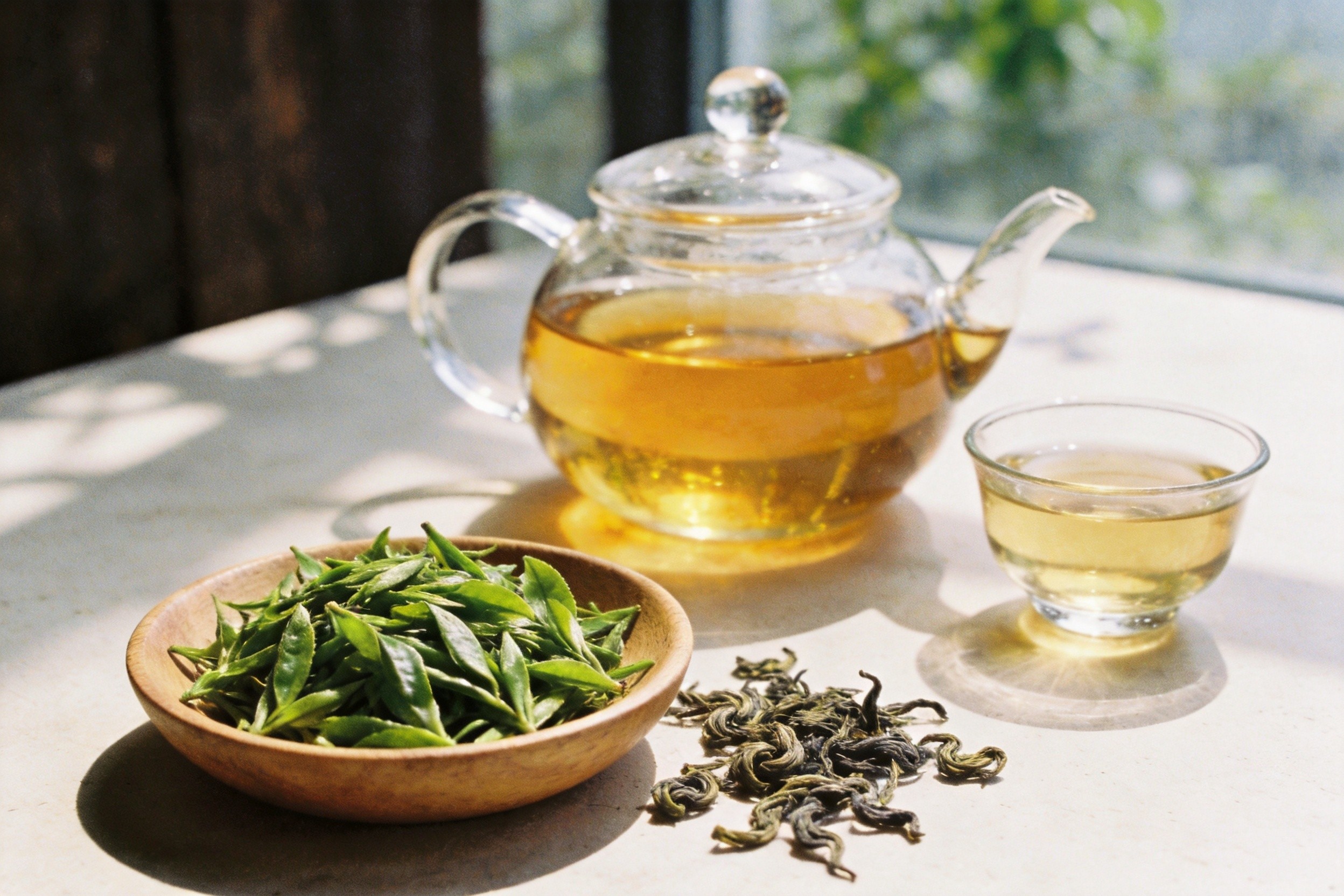
How Tea Is Made: The 5 Processing Steps Explained
Every true tea — green, white, yellow, oolong, black, dark — comes from the same species, Camellia sinensis. What separates them is five processing stages: withering, rolling, oxidation, fixation and drying. The catch is that almost no tea passes through all five in the same order. Green tea is fixed before it can oxidize, black tea is never fixed at all, white tea is neither rolled nor fixed, and dark tea is usually not withered. The sequence, not just the presence of the steps, is what decides the category.
One Plant, Five Stages, Six Different Answers
Processing decides the category. Cultivar and growing conditions decide the character within it. The same leaf can become green tea or black tea depending on whether it meets heat before or after oxidation — but a small-leaf Chinese cultivar and a large-leaf Assam cultivar will never produce the same oolong. Both things are true at once, which is why “all tea is one plant” is a good starting point and a misleading ending point. If you want the plant-versus-tisane distinction first, our guide to true tea vs herbal tisanes covers it.
Here is how the six families actually route through the five stages:
表格
| Tea | Withering | Rolling | Oxidation | Heat |
|---|---|---|---|---|
| Green | Short or skipped | Yes | None — fixed first | Kill-green, then dried |
| Yellow | Short or skipped | Yes | None | Kill-green, sealed yellowing, dried |
| White | Long — the main event | No | Minimal | Air-dried, no kill-green |
| Oolong | Yes | Bruising only | Partial | Kill-green late, then dried |
| Black | Yes | Yes | Full | Dried only, never fixed |
| Dark | Usually none | Yes | Minimal | Kill-green, dried, then pile-fermented |
Stage 1: Withering — Losing Water Without Losing the Leaf
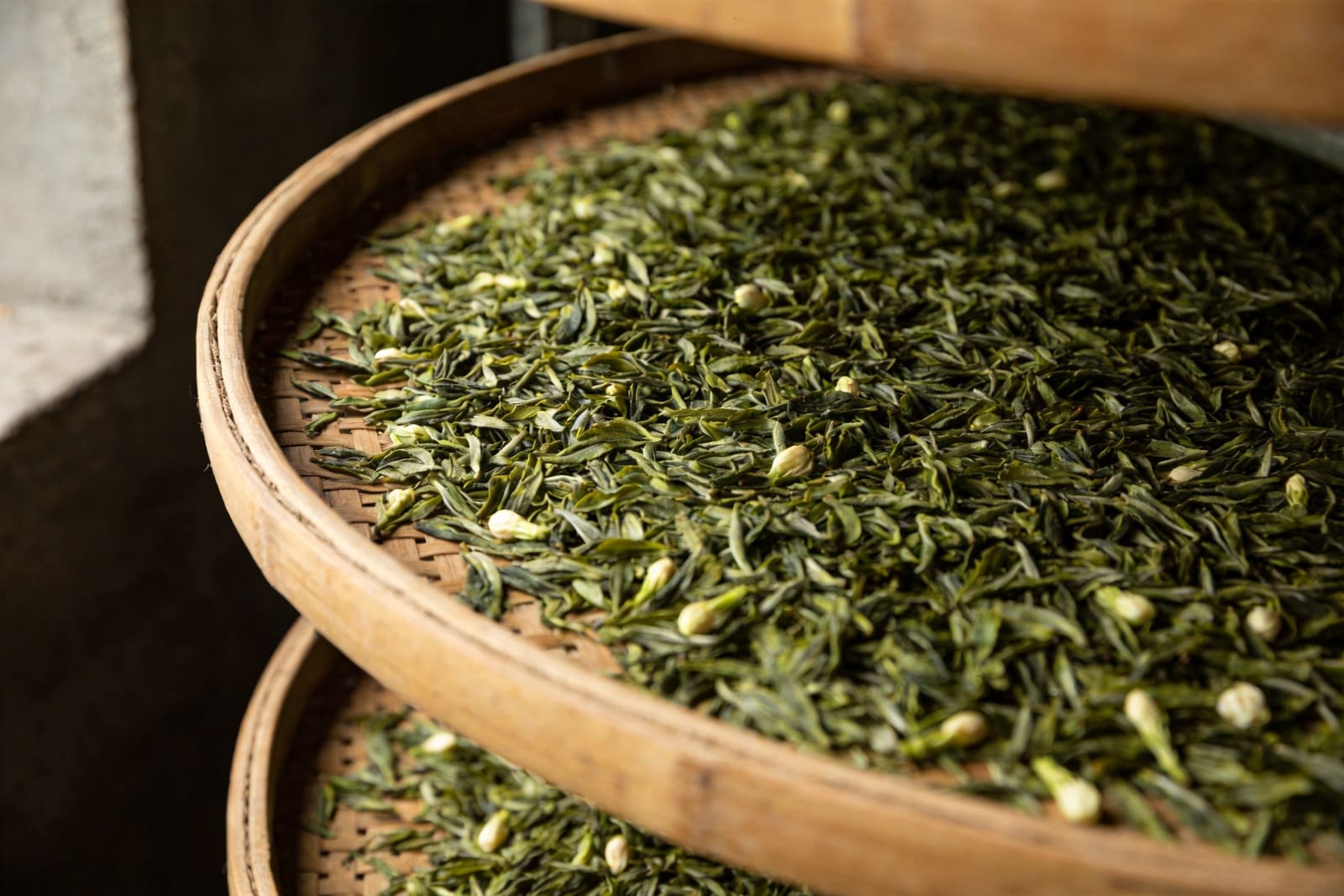
Fresh leaf is mostly water: 75–83% at the moment of plucking. It is turgid and snaps rather than bends, which makes it useless for rolling — the leaf would shatter instead of twisting. Withering spreads the leaves in thin layers with moving air until moisture drops below about 70% and the leaf goes limp without going dry.
That threshold is not cosmetic. A properly withered leaf rolls into a whole twist; an under-withered leaf tears, and torn tissue oxidizes unevenly. Wither too hard and polyphenol oxidase activity falls, which in black tea means fewer theaflavins and a thinner, less brisk cup.
White tea inverts the usual hierarchy. Withering is not preparation for white tea — it is the making of it. Leaves are spread and left for a day or more, sometimes with a little sun, and that slow moisture loss plus the leaf’s own residual chemistry produces the honeyed, hay-like character. No rolling follows, and no fixation.
Green tea barely withers: a few hours of spreading to shed the raw, grassy smell, then straight to the wok. Dark tea is usually not withered at all.
Stage 2: Rolling — Breaking Cells, Not Leaves
Rolling is mechanical. Pressure twists the leaf and ruptures cell walls, which does two things at once: it brings the leaf’s own enzymes into contact with its polyphenols, and it spreads aromatic oils onto the surface where you can smell them.
How much disruption you apply decides how much oxidation follows. Orthodox rolling for black tea is gentle and repeated, producing whole twisted leaf. CTC machines — crush, tear, curl — shred the leaf into fine particles for teabags, which oxidizes faster and more completely and yields a stronger but coarser cup.
Oolong does something different again. Rather than rolling whole leaves, makers bruise only the edges, traditionally by shaking the leaf in a bamboo drum, then let the bruised rims oxidize while the center stays green. Repeated bruise-and-rest cycles produce the “green leaf with a red rim” that defines the category.
White tea skips rolling entirely, which is one reason it still looks like dried leaves rather than manufactured tea.
Stage 3: Oxidation — Where Green and Black Diverge
Oxidation is the step everyone has heard of and most people misname. In black tea production the old word “fermentation” refers to enzymatic oxidation: polyphenol oxidase (PPO) converts catechins into o-quinones, which polymerize into theaflavins — the compounds behind brightness and briskness — and thearubigins, which supply color and body. No microorganism is involved. The leaf is oxidizing itself.
Black tea typically oxidizes for 45 minutes to three hours depending on temperature, humidity and the style being made. The color moves from green to copper to dark brown, and the smell moves from cut grass to apple to malty.
Green tea oxidizes for zero minutes — not because the leaf lacks the enzyme, since it has plenty, but because heat destroys the enzyme before it can work. Which brings us to the step that actually decides the category.
Stage 4: Fixation — The Step That Decides the Category
Fixation, or kill-green, is a burst of heat that deactivates PPO and peroxidase. Japanese green teas are steamed for under a minute; Chinese green teas are pan-fired in a hot wok and hand-tossed so the leaf does not scorch. Either way the leaf keeps its green color, its vegetal aroma and its catechin content.
Now the timing logic falls into place:
- Heat before oxidation produces green tea.
- Heat after partial oxidation produces oolong.
- No heat at all produces black tea, which is simply dried once oxidation is judged complete.
The same five tools, rearranged, give different drinks. Fixation is the switch.
Yellow tea uses fixation twice over. The leaf is kill-greened, then while still warm and moist it is wrapped or piled and left to sit — the step called men huang, sealed yellowing. Because the enzymes are already dead this is not oxidation, and because no microbial pile is involved it is not fermentation either. It is a wet-heat, non-enzymatic transformation: chlorophyll degrades into pheophytin and the leaf turns gold, catechins restructure, amino acids shift toward the sweet end. The result tastes like a green tea that has been talked out of its sharpness.

Stage 5: Drying — Locking It In
Firing dries the leaf to roughly 3–5% moisture so it can be stored without spoiling, which is the same principle behind everything in our guide to how long tea lasts. But heat does more than remove water. It drives the Maillard reaction between amino acids and sugars, and it epimerizes catechins, softening a harsh, bitter edge into something rounder. Aroma compounds — aldehydes, esters, pyrazines — build during this stage, which is why a well-fired tea smells of toast, cocoa or roasted nuts rather than grass.
Drying is also a flavor dial. Hōjicha is fired hot enough to brown the leaf and make the cup nutty. Roasted oolong is re-fired repeatedly for a heavier, warmer profile. Same leaf, same stages, different final heat.
Dark tea adds a sixth move that no other category has. After drying, the leaf is piled and moistened so that molds and bacteria — chiefly Aspergillus species — transform it over weeks or months. This is the only genuine microbial fermentation in tea, and the reason pu-erh ages rather than merely stales.
Frequently asked questions
**Does all tea come from the same plant?**Yes — all true tea is Camellia sinensis. But “same plant” does not mean “same leaf.” Cultivars differ in leaf size, hardiness and chemistry, and they shape what a tea can become: large-leaf Assam types suit black tea, small-leaf Chinese types suit green and oolong. Processing sets the category; the plant sets the range.
**What is the difference between oxidation and fermentation in tea?**Oxidation is enzymatic and needs no microorganisms: leaf enzymes react with oxygen, which is what turns a leaf black. True fermentation only happens in dark tea, where a moistened pile is transformed by living molds and bacteria. Calling black tea “fermented” is a historical habit, not a description of what happens.
**Why is white tea not rolled?**Rolling exists to shape the leaf and to start oxidation by mixing enzymes with polyphenols. White tea is made precisely to avoid that, so rolling would work against the style. The leaf is withered slowly and dried, and the minimal processing is the point.
**Does green tea have fewer processing steps?**No — it uses the same stages but skips oxidation entirely, and it demands the most precise fixation of any category. Over-fire and the tea turns smoky; under-fire and the enzymes keep working, turning the leaf dull and the cup harsh.
Key Takeaways
- Five stages, different orders. Withering, rolling, oxidation, fixation and drying make every tea, but almost no tea uses all five in sequence. Fixation timing is the switch between green, oolong and black.
- Withering is water management. Fresh leaf is 75–83% water and must drop below roughly 70% before it can be rolled without tearing. White tea turns this prep step into the whole method.
- Rolling starts oxidation. Rupturing cells brings enzymes and polyphenols together. Bruise only the edges and you get oolong; skip rolling and you get white tea.
- “Fermentation” is a misnomer. Black tea is enzymatically oxidized by its own polyphenol oxidase. Real microbial fermentation happens only in dark tea, after drying.
- Drying is flavor, not just storage. Heat drives the Maillard reaction and softens bitterness, which is why firing temperature and roast level change the cup so much.
Comments (0)